Lockdown areas in Space
Overview
A lockdown area is a defined area where all access points can be locked or unlocked in an emergency situation. For example, a lockdown area in a university campus could be all access points in the physics building. If there is ever a security threat (or other type of emergency situation) within that building, you can choose to lock or unlock all the doors as appropriate.
The lockdown functionality is license-dependent. See Registering and licensing Space for more information.
See Lockdown monitoring for information about unlocking and locking lockdown areas.
You cannot use Lockdown monitoring in Space to lock and unlock offline doors in an emergency situation. However, if offline doors are fitted with AMOK locks, which have two readers, like the Salto XS4 Original AMOK model, you can give users permissions to do a manual lockdown. To do this, you must select the Set lockdown option on the User information screen. This means that users can enable and disable lockdown mode for the doors by presenting their key to the door's inside reader. You can also give users permissions to unlock both online and offline doors when they are in lockdown by selecting the Override lockdown checkbox on the User information screen. See Key options for more information.
The following sections describe how to create and associate lockdown areas within Space.
Creating lockdown areas
To create a lockdown area, do the following:
- Select Access points > Lockdown areas. The Lockdown areas screen is displayed.
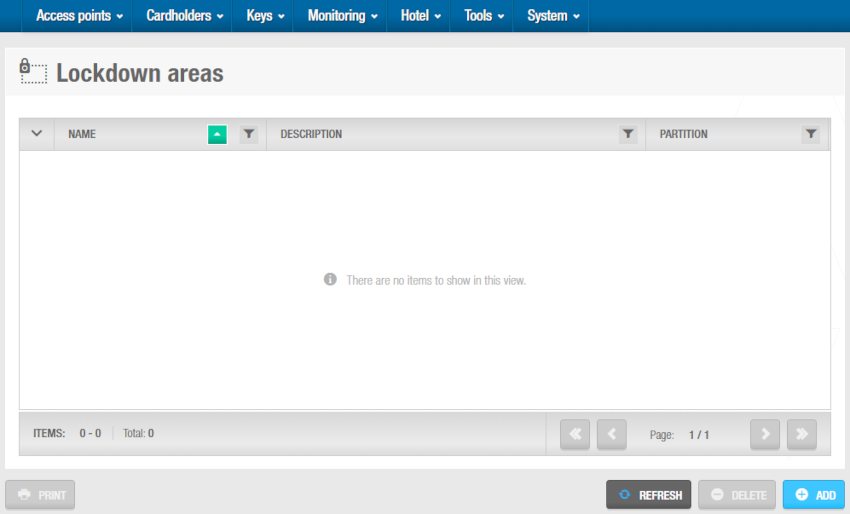 'Lockdown areas' screen
- Click on Add. The Lockdown areas information screen is displayed.
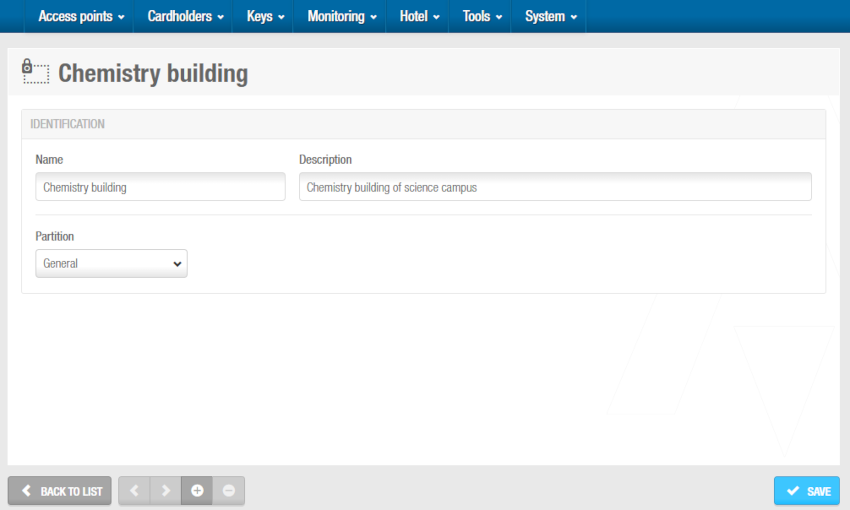 'Lockdown area' information screen
Type a name for the lockdown area in the Name field.
Type a description for the lockdown area in the Description field.
Select the relevant partition from the Partition drop-down list, if required. See Partitions for more information.
Note that the partitions functionality is license-dependent. See Registering and licensing Space for more information.
- Click Save.
Associating lockdown areas
Once you have created a lockdown area, you must associate access points with that lockdown area. The following section describes how to associate lockdown areas with access points.
Access points
To associate an online access point with a lockdown area, follow the steps below:
Select Access points > Lockdown areas. The Lockdown areas screen is displayed.
Click the lockdown area that you want to associate with an access point. The Lockdown area information screen is displayed.
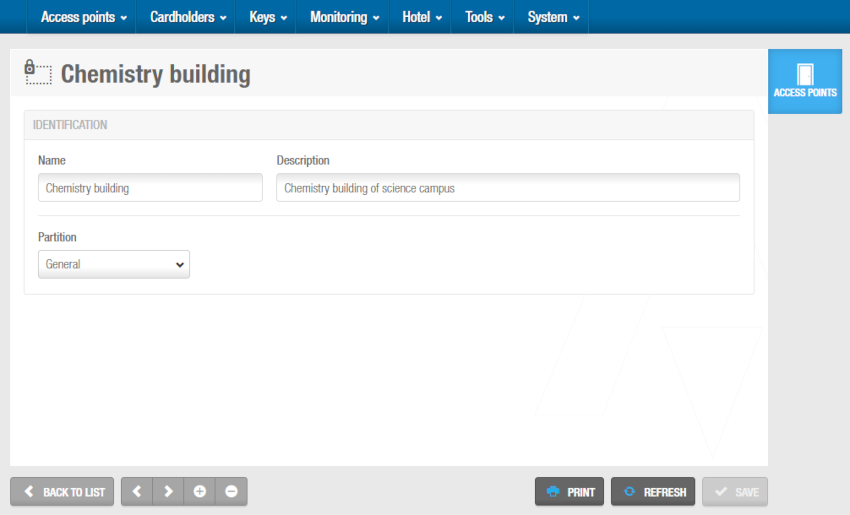 'Lockdown area' information screen with the sidebar
- Click Access points in the sidebar. The Access points dialog box is displayed.
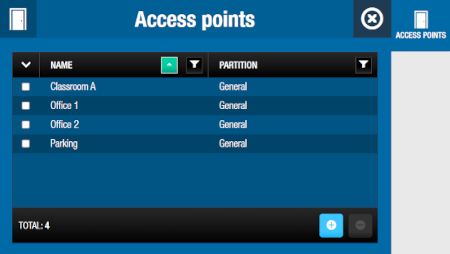 'Access points' dialog box
Note that the dialog box will be blank if you have not yet associated an access point with this particular lockdown area.
Click Add. The Add dialog box, showing a list of access points, is displayed.
Select the required access point and click on Save & Close. The access point is now associated with the lockdown area.
To dissociate a lockdown area from a door, from the Access point dialog box of the specific lockdown area, do the following:
Select the access point to be dissociated.
Click on Delete and confirm the action in the Warning dialog box.
Disclaimer
The information provided by Salto above is intended as guidance and is for informational purposes only. Actual system performance may vary based on external factors including but not limited to interference from other wireless signals (including multiple Bluetooth devices), the stability of the network connection (including internet and power stability), physical barriers blocking the signal (including metal structures such as doors, furniture, appliances or other objects) or other environmental factors (including high radio noise, electromagnetic interference, etc.). These factors could contribute to signal degradation or connectivity issues, including but not limited to delayed or failed wireless updates and commands or wireless communications latency.
Wireless reliability depends on the installation conditions including the number of locks installed per node, the distance between Salto gateways, nodes, and locks, and the operability of each gateway.
When implementing and maintaining BLUEnet wireless systems within the Salto Space platform, Salto Partners and customers are responsible for following the best practices set forth in the "BLUEnet Wireless Infrastructure recommendations" document. Please contact Salto to obtain a copy.
If locks are to be used for critical actions such as Lockdown, partners and customers must comply with the specific recommendations set forth in the "BLUEnet Wireless Infrastructure recommendations" document, including limiting the number of locks to 2 per node and installing a designated firmware version. This firmware update may impact battery life.
Given potential variability and unpredictability of these factors, Salto does not guarantee instantaneous communication between a command to lock or unlock doors and the physical lock on the doors. Activation can take several seconds and depends, among others, on the network.
Firmware or software updates may be required for proper operation. Customers are responsible for keeping their firmware and software versions up to date. Regular tests of the system are recommended to ensure proper operation. Important: Salto's system is not intended for use as a primary life-safety device. Wireless locks are intended to complement, not replace, other physical or procedural security measures.
All inquiries or requests for additional information should be submitted or directed to Salto.
 Back
Automatic changes
Back
Automatic changes Roll-call areas