Installing the Space components
About installing
Before reading this guide you should first make sure you have read and understood the section on system requirements and considerations for installing Space.
This section contains a step-by-step guide on how to install and configure the software components required to access and use Space. You need to carry out two separate installation processes:
- ProAccess Space (which includes the installation of the Space service and the ProAccess Space Configurator)
- Local IO Bridge (which you can download from within the Space software once you've finished installing it)
Install the Local IO Bridge only if you are going to use USB devices, such as encoders or PPDs connected via USB.
Installation process
The installation process should be made in the following order by an systems administrator with admin rights in Space. This role is referred to here as the admin operator:
Installation prerequisites are checked
The admin operator checks that the correct hardware and software requirements are met before beginning the installation process.
Space installation files are obtained
- The admin operator (or other appropriate manager) selects the appropriate licensing options as part of purchasing Space.
- The admin operator registers the Space serial number on the Salto website.
- The admin operator downloads the software.
Space software components are installed
- The admin operator installs ProAccess Space.
- The admin operator installs the Local IO Bridge.
Installing the Space components
To set up Space, you need to install two separate files:
Setup_ProAccessSpace.exe: This installs ProAccess Space, the ProAccess Space Configurator, and the Space service.Setup_SaltoLocalIOBridge: This installs the Local IO Bridge.
Installing Space
ProAccess Space, the Space service, and the ProAccess Space Configurator are installed together from the one installation file. The Space installation procedure covers the installation for all of them.
To install Space, do the following:
Unzip the ProAccess Space installation file.
Right-click the
Setup_ProAccessSpace.exefile.
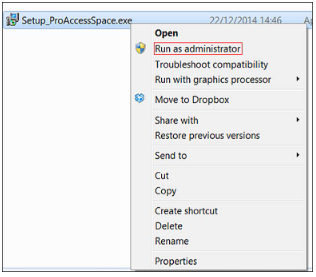 Run as administrator
Select Run as administrator.
Click Yes when prompted with the following message:
"Do you want to allow the following program from an unknown publisher to make changes to this computer?"
The initial installation dialog box is displayed.
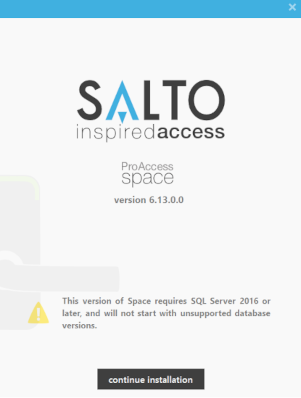 'Warning version message' dialog box
- Click Continue installation when prompted with the following message:
- "This version of Space requires SQL Server 2016 or later, and will not start with unsupported database versions."
You can check whether the SQL Server version is 2016 or later from the Database tab in the ProAccess Space Configurator. If your SQL Server version is earlier than 2016, an error message is displayed.
- The license agreement dialog box is displayed. Select "I agree to the terms and conditions" and click next.
 'License agreement' dialog box
- The destination folder dialog box is displayed. Choose a different location or accept the suggested installation destination folder.
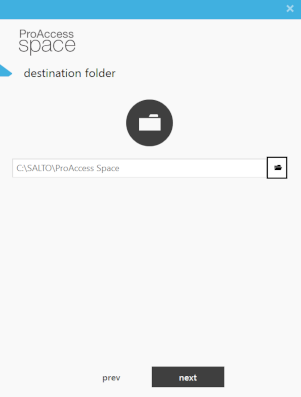 'Destination folder' dialog box
- Click next. The configure data backend dialog box is displayed.
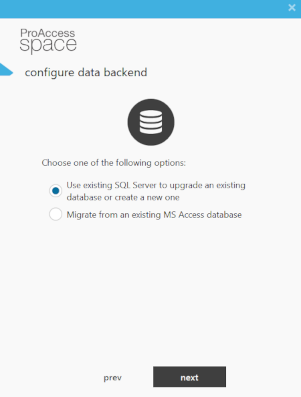 'Configure data backend' dialog box
Select either Use existing SQL Server to upgrade an existing database or create a new one or Migrate from an existing MS Access database.
If you are intending to create a new database or select one from an existing SQL Server engine as part of the installation process, see Using an existing SQL server engine for more information.
If you are intending to migrate data from a Microsoft (MS) Access database as part of the installation process, see Migrating data from a Microsoft Access database for more information.
Click next. The activate software dialog box is displayed.
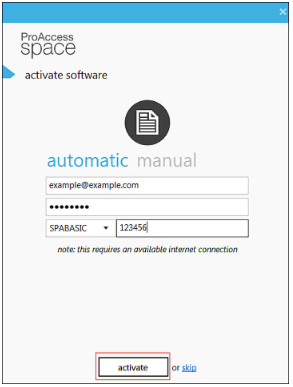 'Activate software' dialog box
- Type the email address and password you used to register.
You can activate your version of Space using the manual tab if you have already received the license data (.dat) file.
Select your license type from the drop-down list (SPABASIC, SPAONLINE, etc.).
Type your serial number.
Click activate. The Well done! screen, confirming that Space has been installed, is displayed.
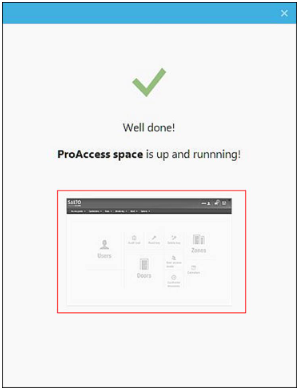 'Installation confirmation' screen
You can click the quick-access tile to start using Space.
Using an existing SQL server engine
After you select the installation destination folder in step 7 of Installing Space, the configure data backend dialog box is displayed.
You can choose to use an existing SQL server engine in one of two ways:
- Use an existing database for the installation.
- Create a new database for the installation.
Using an existing database
To install Space using an existing database, do the following:
- Select Use existing SQL Server to upgrade an existing database or create a new one.
'Configure data backend' dialog box
- Click next.
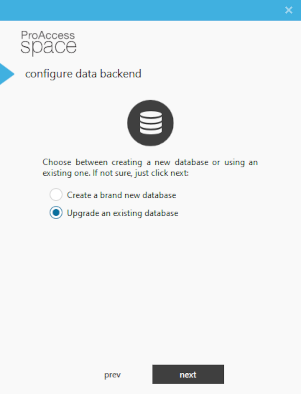 Upgrade an existing database
- Select Upgrade an existing database and click next.
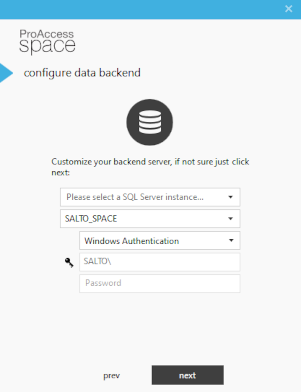 Select the SQL database
Enter the appropriate SQL server, the new SQL database and the authentication method details.
Click next.
Follow step 10 in Installing Space to continue with the installation.
Creating a new database
To install Space using a new database, do the following:
- Select Use existing SQL Server to upgrade an existing database or create a new one.
'Configure data backend' dialog box
- Click next.
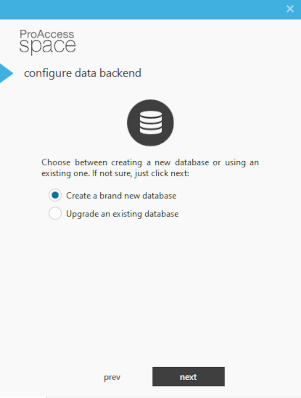 Create a brand new database
- Select Create a brand new database and click next.
Existing SQL database details
Enter the appropriate SQL server, the new SQL database and the authentication method details.
Click next.
Follow step 10 in Installing Space to continue with the installation process.
Migrating data from a Microsoft Access database
After you select the installation destination folder in step 7 of Installing Space, the configure data backend dialog box is displayed.
To install Space by migrating data from a Microsoft Access database, do the following:
- Select Migrate from Microsoft Access.
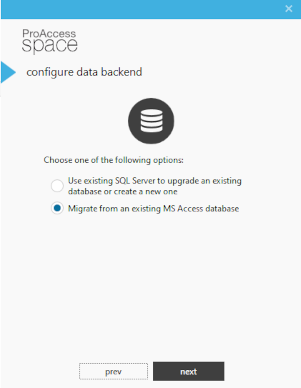 Migrate from Microsoft Access
- Click next.
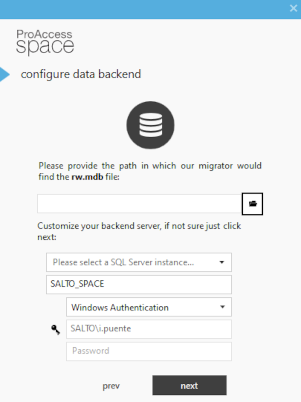 'RW.mdb' file location
Select the location of the
rw.mdbfile by clicking the folder icon and customize your backend server settings.Click next.
Follow step 10 in Installing Space to continue with the installation process.
Installing the Local IO Bridge
The Local IO Bridge must be installed on any client PCs you intend to use with a USB encoder or PPD. The Local IO Bridge allows USB devices to be used with Space by creating a link between the USB device and the browser.
To install the Local IO Bridge, you must first log in to Space as an operator with admin rights. See Logging in for information about how to log in to Space. You can install the Local IO Bridge from within Space in two ways:
Installing from the 'Settings' screen
To install the Local IO Bridge from the Settings screen, do the following:
- Click admin (or other appropriate operator login) on the top right-hand side of the home screen. The Settings screen is displayed.
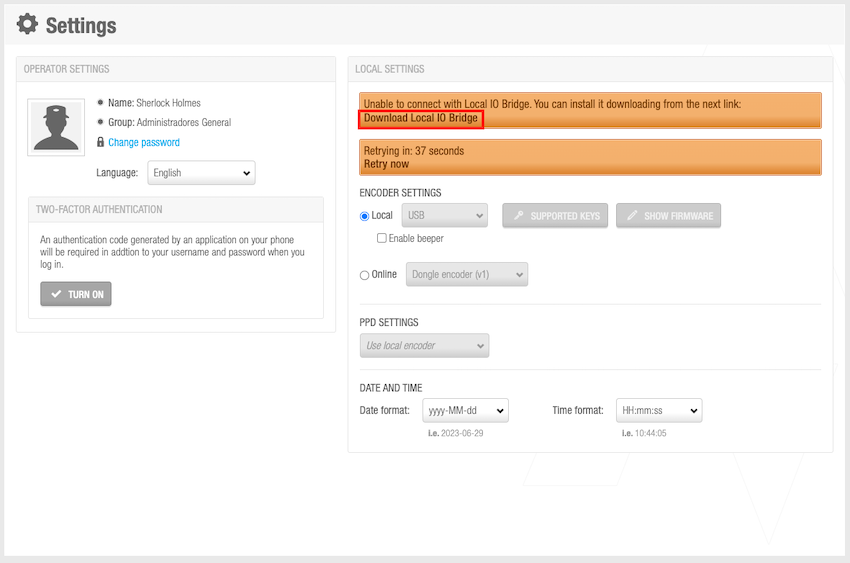 Settings screen
Click Download Local IO Bridge.
Click Save when prompted with the following message:
- "Do you want to run or save
Setup_SaltoLocalIOBridge.exe?"
- "Do you want to run or save
Save the
Setup_SaltoLocalIOBridge.exefile to your computer and right-click it.Select Run as administrator.
Click Yes when prompted with the following message:
- "Do you want to allow the following program from an unknown publisher to make changes to this computer?"
The initial installation dialog box is displayed.
- Click next. The license agreement dialog box is displayed.
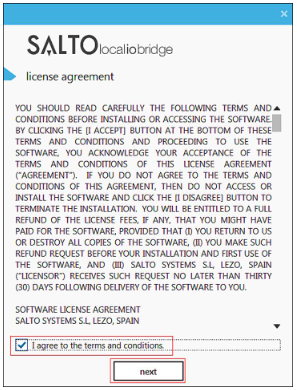 'License agreement' dialog box
Select I agree to the terms and conditions.
Click next. The destination folder dialog box is displayed.
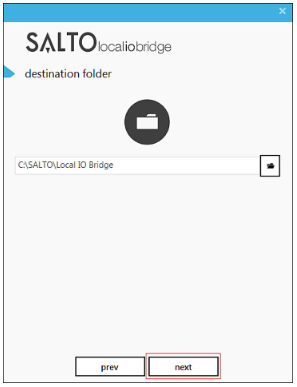 'Destination folder' dialog box
Choose a different location or accept the suggested installation destination folder.
Click next. The succeeded dialog box, confirming that the Local IO Bridge is installed and asking you to unplug and plug back in any Salto USB devices, is displayed.
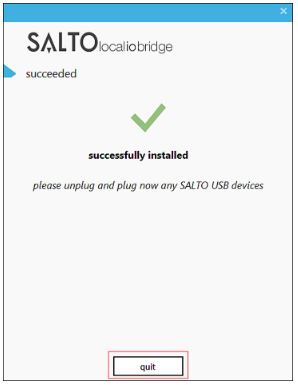 Installation confirmation
- Once you have unplugged and plugged back in the required Salto USB devices, click quit.
Installing from the 'About' dialog box
To install the Local IO Bridge from the About dialog box, do the following:
- Click the About icon on the top right-hand side of the home screen. The About dialog box is displayed.
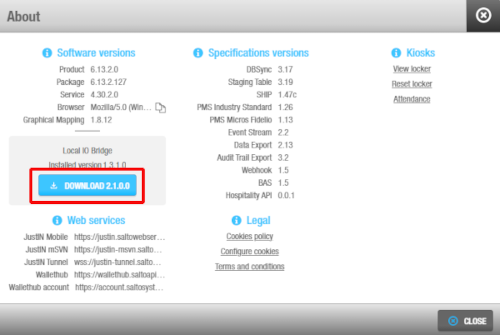 'About' dialog box
- Click Download.
Note that the text of the Download button varies slightly to reflect the latest available version of the Local IO Bridge which corresponds to the installed Space version.
Click Save when prompted with the following message:
- "Do you want to run or save
Setup_SaltoLocalIOBridge.exe?"
- "Do you want to run or save
Save the file to your computer and follow the steps in Installing from the Settings screen.
Local IO Bridge advanced configuration
The Local IO Bridge installation process includes a basic configuration of its certificate and port. However, read this section if you need to change the default configuration. You may need to use the advanced configuration to specify a particular HTTPS port (from the allowed ranges) instead of letting the Local IO Bridge pick a random one or to use a certificate installed in the Windows Certificate Store (for example, one signed by a trusted Certificate Authority) instead of the Local IO Bridge's own self-signed certificate.
Once the Local IO Bridge has been installed, the file called service.ini that was generated in the same folder where the Local IO Bridge was installed, must be modified.
This file should include the port on which the Local IO Bridge web server should be initiated, which must belong to one of the allowed ranges 1, and the identification parameter of the certificate to be used.
Both the port and the certificate are read only once, when the Local IO Bridge is started, so they do not rotate.
See Service.ini format for more information.
The service.ini file can be edited only by an operator with administrator rights and the Local IO Bridge service must be restarted when any change is made.
The operator must install the certificate that the Local IO Bridge will use in the Windows Certificate Store (LocalMachine). Use only valid certificates that meet the conditions below. Otherwise, communication issues may occur.
- They must be signed by a Certificate Authority trusted by the client machine.
- They must not be expired.
- The selected certificate should be issued for the IP address 127.0.0.1, so the SAN field must include
IP Address=127.0.0.1.
If service.ini does not exist, the Local IO Bridge keeps the automatic behavior, using its own certificate and a random allowed port.
When the certificate advanced configuration is used, the Local IO Bridge web is only accessible over HTTPS.
Service.ini format
The keys that can be configured in the service.ini file are the following:
• HttpsPort
HTTPS port on which the Local IO Bridge web server will be exposed. The value must belong to one of the allowed port ranges. If it is not specified, the web server will start on a random port.
• HttpsCertManual (0—1)
Indicates whether a manually installed certificate from the Windows Certificate Store will be used. Default value if not specified: 0 0 = Use the Local IO Bridge's own certificate, signed by its self-signed CA. 1 = Use a certificate installed in the Windows Certificate Store.
• HttpsCertStoreName
Name of the certificate store where the certificate will be searched. Default value if not specified: My.
• HttpsCertIdentificationMethod (0—1—2)
Method used to identify the certificate within the store. Default value if not specified: 1 0 = CN 1 = DN 2 = Issuer
• HttpsCertIdentificationMatchValue
Value that will be used to identify the certificate according to the method defined in HttpsCertIdentificationMethod.
Refer to step 3 within the process to configure the Automatic refresh certificate mode in section Checking configuration for more information.
• HttpsCertSelectionStrategy (0—1)
Strategy used to select the certificate if multiple certificates match the search criteria.
Default value if not specified: 0
0 = Select the certificate with the most recent NotBefore date.
1 = Select the certificate with the latest NotAfter date.
The configuration of the port and certificate in service.ini is independent and it is possible to only specify the port, the certificate, or both of them.
Although the number of available parameters may make the configuration seem complex, in some cases it will be enough to define HttpsPort, HttpsCertManual, and HttpsCertIdentificationMatchValue, since the remaining parameters have default values.
The goal is to keep the configuration simple for common use cases while still allowing a high degree of configurability for more specific environments or requirements.
Footnotes
Allowed ranges: 50000—50009, 50110—50119, 50220—50229, 50330—50339, 50440—50449, 50550—50559, 50660—50669, 50770—50779, 50880—50889, 50990—50999. ↩︎
 Back
Back
